
The SWAT MAPS team is excited to welcome AgronomyTec as a new SWAT MAPS service provider located in...
The Paradox of Nutrient use Efficiency
When fertilizer is applied, we want all those nutrients to be taken up by the crop, right? And the more fertilizer that gets into the crop the better? Yes… and no. That’s the paradox of nutrient use efficiency (NUE).
This starts with the complexity of how NUE is measured. There are many ways to measure NUE, explained in “Defining nutrient use efficiency in responsible plant nutrition” (The Scientific Panel on Responsible Plant Nutrition, 2023). The method used depends on what you want to learn and measurements that are available. But the end goal is largely the same: To understand how agriculture can provide nutrients to crops while minimizing their environmental impact.
While it would be outstanding to measure 90+% uptake of an applied nutrient in the year of application, it’s not very realistic for most nutrients and crops grown in soil. Crops acquire most of their nutrients from the soil. A recent example of this with phosphate uptake in corn was published, showing 78-92% of early – mid season corn phosphorus came from the soil, not fertilizer. (Chatterjee et al., 2024). Griesheim et al. (2022) measured a range of only 7% to 46% fertilizer nitrogen uptake efficiency in aboveground biomass in corn. The relative amount from soil versus fertilizer depends on the nutrient and the soils’ ability to supply the nutrient, either as “available” when we soil test or through mineralization during crop growth. The more deficient the soil is, the higher the percentage taken up must come from applied fertilizer. So, in a very deficient soil, NUE by many measures will look very good! But is this what we want?
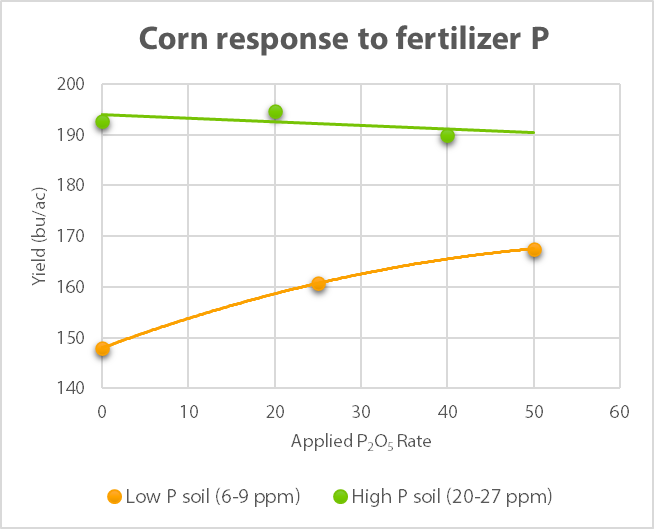
Assuming all other 4Rs are adhered to, very little response to the applied nutrient means the soil is functioning the way we want it to and supplying enough nutrition. All we need to do is continue to monitor soil levels and ensure supply remains sufficient but not excessive. An example is the P response graphs in figure 1. Is the steeper response curve more exciting, or the flat one? Many would say the steep curve - it shows an impressive return on applied phosphate. But ideally, we want the curve to be relatively flat, since that tells us that we’ve done a good job of managing soil nutrient levels and our soil is functioning the way we want it to. This is the intersect of psychology and agronomy – the steep response curve gives us the excitement of knowing there’s an opportunity to fix something, and while that information is valuable, we’d be better off on the flat curve since yield isn’t limited by that particular nutrient.
{ImageLink}
Figure 1. Average corn response to fertilizer P on high P soil vs. low P soil (Leikam et al., 2010).
Given what we do with SWAT MAPS, we are particularly interested in responses by SWAT zone to demonstrate opportunities to use variable rate technology to improve returns on applied nutrients. What if the high yield, flat response curve above was from a well-drained depression with deep topsoil and high soil P, and the lower yielding, steep response curve from an upper landscape position with historical erosion and little topsoil? That’s incredibly valuable information and needed if the industry wants to drive precision ag adoption.
To recap, we want soils that can supply sufficient nutrients to the crop, because that means we don’t have to apply more from fertilizer. But if we achieve that it also means that a very small percentage of fertilizer that we do apply to maintain fertility levels will be taken up in that year, and that’s the paradox. The annual “efficiency” that is often chased is not actually what we want. Whether that H2PO4– molecule taken into a root hair came from a fertilizer granule applied 4 weeks ago or 4 years ago doesn’t really matter. The important thing is it’s there where the root can access it, it’s in high enough concentration to supply what the plant needs, but not so high it risks excessive environmental loss. That SO4-2 molecule that will contribute to high quality protein in your wheat? It may have cycled through many, many microbial proteins before finally entering a crop root years after it was applied as a sulfur fertilizer. The important part is it didn’t leach out of the root zone a week after it was applied. Soil is the ultimate nutrient laundering scheme. It supplies nutrients but we don’t usually know the original source, and frankly does it matter?
Before the inundation of “yeah buts...” I will say that nitrogen in some ways is an exception. Soil can’t reliably “store” nitrate-N. Because nitrate is susceptible to many forms of loss and it has numerous environmental effects in both surface water, groundwater, and the air, we need to be cautious about how much nitrate is available for loss at any given time. The way to mitigate those losses is by following 4R nutrient stewardship, nurturing a healthy, well-structured soil that has a suitable pH, and is nutritionally balanced. All these characteristics tend to reduce the need for applied N, maintain crop yields in a broad variety of climate conditions, and reduce losses.
It is obvious from recent research that healthy agricultural soils provide the majority of nutrient uptake rather than the fertilizer we apply. Which is why we need to understand the soil’s ability to supply these nutrients for a successful precision ag strategy. And no, it is not just a single nutrient value on a soil test. It requires an understanding of carbon cycling across the landscape that is influenced by many things – both chemical and biological.
At Croptimistic we are currently scoping out ways to measure yearly and long-term nutrient use efficiency using a partial balance method. While it's a data intensive process, it will be relatively easy to calculate for farms participating in the Yield Potential Program. It allows us to analyze whether we are building or depleting nutrient levels at the field and zone level or risking environmental losses. It’s a valuable measure of sustainability and helps us make better fertility recommendations.
So, remember, the next time you do a fertilizer trial on your farm and see no results, don’t be disappointed! It might mean you can pat yourself on the back and thank your soil for doing its job.
References:
Chatterjee, N., Li, C., & Margenot, A. J. (2024). 33P-isotope labelling ammonium phosphate fertilizers reveals majority of early growth maize phosphorus is soil-derived. European Journal of Soil Science, 75(5), e13578. https://doi.org/10.1111/ejss.13578
Griesheim, K. L., Mulvaney, R. L., Smith, T. J., & Hertzberger, A. J. (2023). Nitrogen-15 evaluation of fertilizer placement at planting for corn production. Soil Science Society of America Journal, 87, 309–323. https://doi.org/10.1002/saj2.20503
Leikam, D., G. Randall and A. Mallarino. (2010). Are current soil test-based phosphorus and potassium recommendations adequate? Crops & Soils. Vol. 43-6. Pp 27-32.
Scientific Panel on Responsible Plant Nutrition. (2023). Defining nutrient use efficiency in responsible plant nutrition. Issue Brief 04. Available at www.sprpn.org